Sub navigation

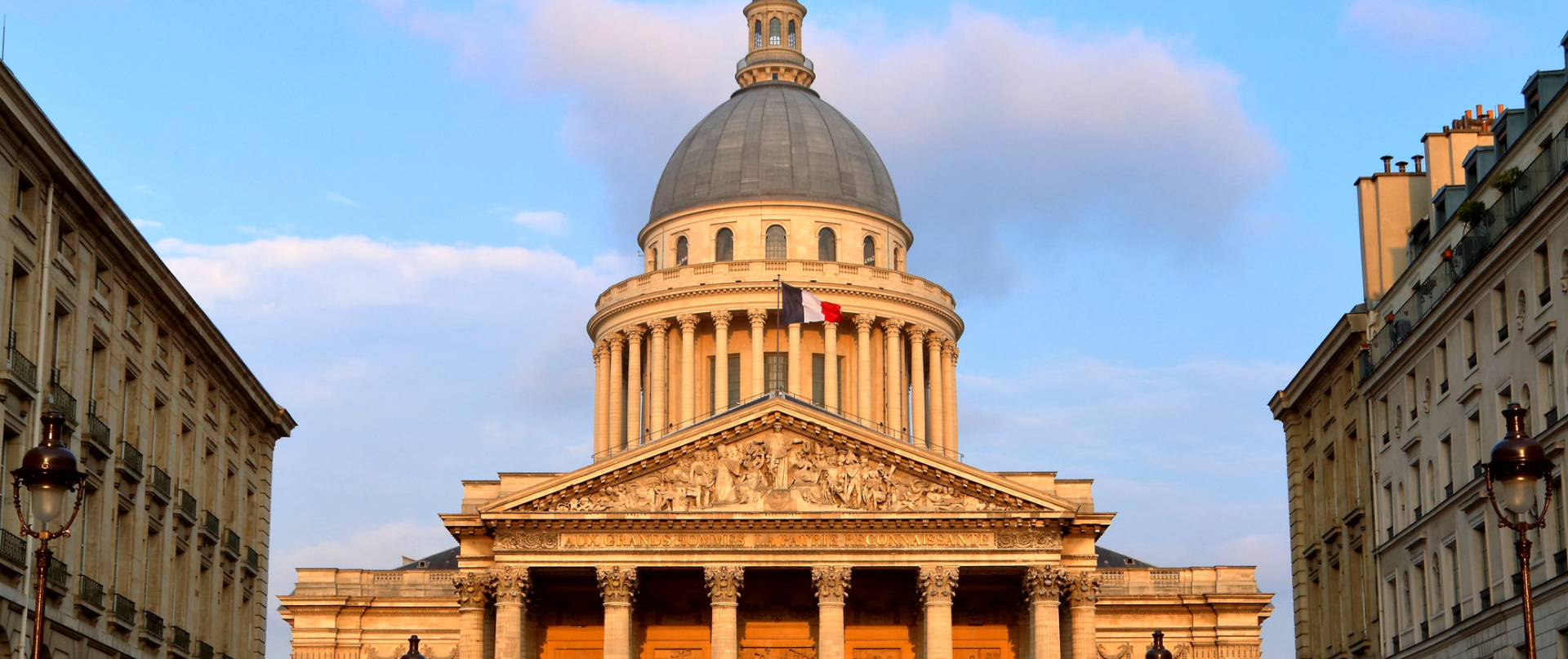
Come and visit the Pantheon (1764-1790), the masterpiece of the architect Soufflot, on the Montagne Sainte-Geneviève in Paris. Discover the famous people buried in the crypt who marked the history and identity of France. Enjoy extensive views over Paris from the external colonnade of the dome.
Visiting the Pantheon
• A grandiose building. Soufflot's ambition was to outdo the churches of St. Peter in Rome and Saint Paul's in London. The monumental peristyle was inspired by the Pantheon of Agrippa in Rome.
• A decorative programme. From 1874 onwards, the sanctuary was decorated with paintings on canvas marouflé illustrating the life of Saint Geneviève and epic story of the beginnings of both Christianity and the monarchy in France.
• The crypt. A permanent exhibition gives details about the lives and works of those who are buried here, from Voltaire to Rousseau or Alexandre Dumas.
• Foucault's pendulum. This demonstrated the rotation of the earth and was first installed in 1851, before being removed and then reinstalled in 1995.
• The upper areas. Access to the dome, by guided tour only, is possible from April to October.
Understanding the Pantheon
• From Christian basilica to national Pantheon. The site was first used as a basilica founded in 507 by King Clovis. In 1755, Louis XV entrusted Soufflot with designing a prestigious building to fulfil a pledge he made in Metz in 1744. In 1791, the monument lost its religious role and became a national Pantheon. On two occasions the enormous sanctuary reverted to being a place of Christian worship before finally being becoming a civic temple in 1885, with the funeral of Victor Hugo.


Download PDF file
French
English
Espanol
Italian
German
Dutch
Portuguese
Russian
Polish
Chinese
Japanese
abo_rss