Sub navigation
Panthéon
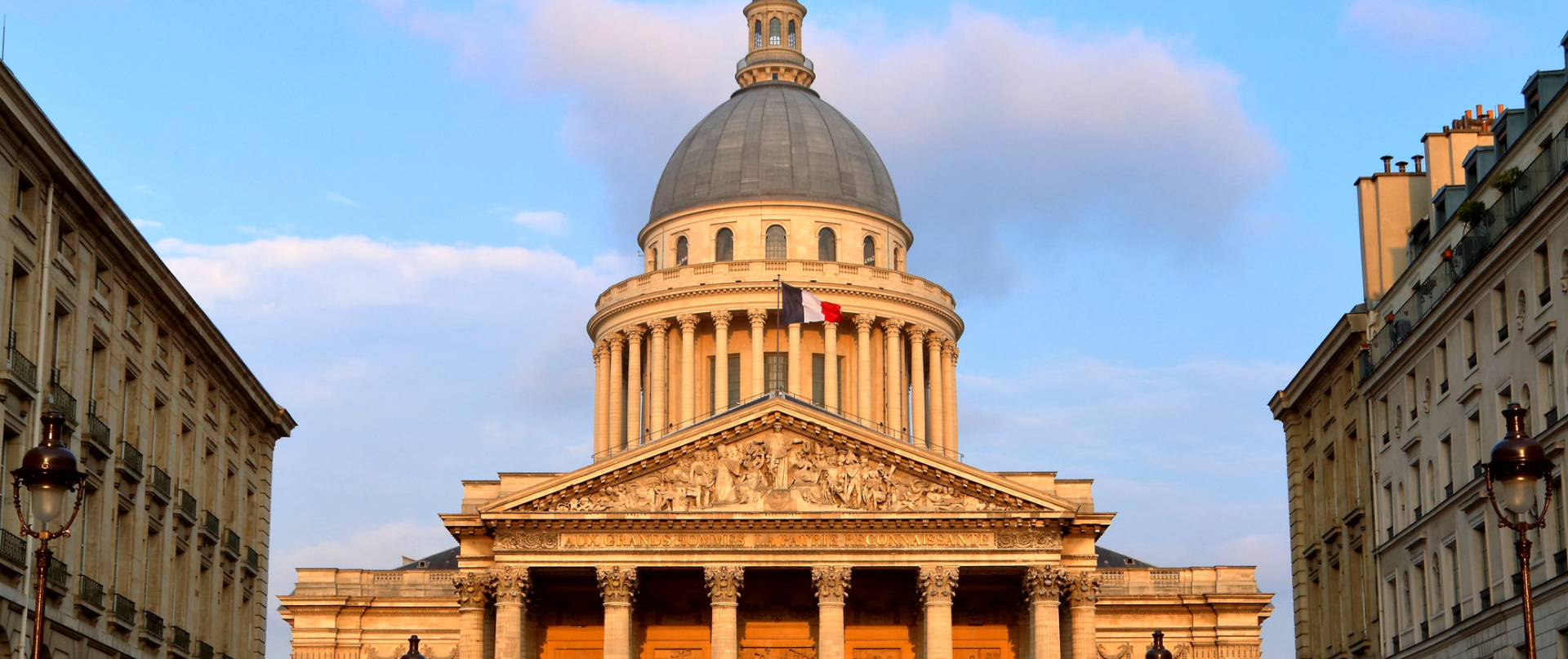
Come and visit the Pantheon (1764-1790), the masterpiece of the architect Soufflot, on the Montagne Sainte-Geneviève in Paris. Discover the famous people buried in the crypt who marked the history and identity of France. Enjoy extensive views over Paris from the external colonnade of the dome.
Ajouter à mon carnet
Recommander cette page
Opening / Closing
Times may vary
Open
April 1 to September 30 : 10-6:30
October 1 to March 31 : 10-6
Last admission 45 mins before closing
Closed
on January 1, May 1 and December 25
Prices

Adult rate : 8 €
Reduced rate : 5 €
Adult group rate : 6 € (minimum 20 persons)
School group rate : 30 € (maximum 35 persons)
Free admission :
Minors under 18 (family visit)
18-25 years old (for people under 26 years old who are citizens of one the 27 countries of EU or are non-European permanent residents of France)
Disabled visitors and their escorts
Unemployed persons
Going there
Métro: line 10
Bus: lines 21, 27, 38, 82, 84, 85 and 89
RER: line B
By car: boulevard Saint-Michel and rue Soufflot
Localisation
Place du Panthéon
75005 Paris
F 33 / (0)1 44 07 32 23
Coordonnées GPS
Longitude : 2.3461
Weather
Thursday
23°C
Thu
52°C / 74°C
Fri
52°C / 73°C
Sat
52°C / 73°C
Sun
53°C / 72°C
Discover
Visit
Ajouter à mon carnet
Visiting the Pantheon
• A grandiose building.
Soufflot’s ambition was to outdo the churches of St. Peter in Rome and
Saint Paul’s in London. The monumental peristyle was inspired by the
Pantheon of Agrippa in Rome.
• A decorative programme.
From 1874 onwards, the sanctuary was decorated with paintings on canvas
marouflé illustrating the life of Saint Geneviève and epic story of the
beginnings of both Christianity and the monarchy in France.
• The crypt.
A permanent exhibition gives details about the lives and works of those
who are buried here, from Voltaire to Rousseau or Alexandre Dumas.
• Foucault’s pendulum. This demonstrated the rotation of the earth and was first installed in 1851, before being removed and then reinstalled in 1995.
• The upper areas. Access to the dome, by guided tour only, is possible from April to October.
Understanding the Pantheon
• From Christian basilica to national Pantheon. The
site was first used as a basilica founded in 507 by King Clovis. In
1755, Louis XV entrusted Soufflot with designing a prestigious building
to fulfil a pledge he made in Metz in 1744. In 1791, the monument lost
its religious role and became a national Pantheon. On two occasions the
enormous sanctuary reverted to being a place of Christian worship
before finally being becoming a civic temple in 1885, with the funeral
of Victor Hugo.
Visits
Unaccompagnied visit
français, anglais, allemand, espagnol, italien, russe, polonais, portugais, chinois
durée : 1h
Guided visit
sur réservation : 1 mois et demi
durée : 45 mn
contacter Sophie Gosley (sophie.gosley@monuments-nationaux.fr)
NULL
visite guidée pour individuels l'après-midi (durée 45 mn).
Pour confirmation de l'horaire appeler à l'avance : Tél : 01.44.32.18.00
Visit with commentary
sur réservation : tél. (33) 01 44 54 19 30 ; fax (33) 01 44 54 19 31
durée : 1h30
Gift and book shop
Guide Dog allowed
Dogs excluded
Accessibilité
Visites libres
Visites guidées
Audiovisuel
. dans la nef : un audiovisuel commente l'expérience du pendule de Foucault
. dans la crypte : un petit audiovisuel composé de films d'archives retrace les "panthéonisations" de Zola à Dumas
Transports
RER B : arrêt Luxembourg
METRO : ligne 10, arrêt Maubert-Mutualité
Parkings à proximité : place du Panthéon (à 50 m de l'entrée du monument)
Entrée gratuite
. pour les personnes handicapées en individuel sur présentation d'un justificatif
. pour les groupes de personnes handicapées venant d'institutions spécialisées (avec attestation du directeur de l'organisme)
Tarifs préférentiels pour les activités culturelles.
Visiteurs à mobilité réduite
Espaces accessibles :
Aucun espace du monument n'est de plain pied.
Pas d'ascenseur ni de plan incliné.
Sol en pierre et en marbre.
Une vingtaine de marches permettent d'accéder au monument (niveau du péristyle), puis une dizaine d'autres permettent d'accéder au niveau haut de la nef.
L'accès à la crypte s'effectue par un escalier hélicoïdal ou en équerre (ce dernier n'est pas ouvert en hiver).
Zônes de repos :
Une dizaine de bancs se trouvent dans la nef et la crypte
Sanitaires :
Non adaptés
Transports :
RER B : arrêt Luxembourg
METRO : ligne 10, arrêt Maubert-Mutualité
Parkings à proximité : place du Panthéon (à 50 m de l'entrée du monument)
Visiteurs déficients intellectuels
Visite libre : nef, crypte
Audiovisuel :
. dans la nef : un audiovisuel commente l'expérience du pendule de Foucault
. dans la crypte : un petit audiovisuel composé de films d'archives retrace les "panthéonisations" de Zola à Dumas
Visiteurs sourds et malentendants
Visites guidées en langue des signes pour les groupes
Réservation obligatoire : pour tous renseignements ou réservation, vous pouvez au choix :
. écrire à l'antenne pour le public sourd, Centre des monuments nationaux, hôtel de Sully, 62 rue Saint Antoine, 75004 Paris
. envoyer un fax à cette même antenne au
01 44 61 21 41
. entrer en contact avec Jean-Paul Perbost, conférencier responsable de l'antenne, jean-paul.perbost@monum.fr
Visiteurs mal et non-voyants
Visite libre avec un livret tactile disponible sur demande à l'accueil (document de visite en gros caractères et en braille ; planches en relief). Sans réservation.
Visite tactile adaptée en français pour groupes. Sur réservation auprès de Sophie Gosley, Panthéon, place du Panthéon, 75005 Paris, tél.01 44 32 18 01, fax 01 44 07 32 23, sophie.gosley@monuments-nationaux.fr
Cette visite associe commentaire historique, découverte tactile de certains éléments architecturaux (dont la tombe de Louis Braille) et appréhension de planches en relief.
Téléchargez votre document de visite
Local monuments
Services
Librairie-boutique
Explore
Voir l’avis des internautes
Avis des internautes
Soyez le premier à donner votre avis !


Read more
French
English
Espanol
Italian
German
Dutch
Portuguese
Russian
Polish
Chinese
Japanese